Showing posts with label Feast Days. Show all posts

Canadian Martyrs and a Question

26 September 2017

I have a question for anyone out there. Why was the Canadian feast day for our martyrs set for Sept. 26, while in the US it is on Oct 19 (corresponding wiht St. Isaac Jogues' death)?

Either way, happy feast day. If you wish, the following is from the CCCB website:

The Canadian Martyrs:

Jesuits
Saint Isaac Jogues (1608-1646)
Saint Antoine Daniel (1600-1648)
Saint Jean de Brébeuf (1593-1649)
Saint Gabriel Lalemant (1610-1649)
Saint Charles Garnier (1606-1649)
Saint Noël Chabanel (1613-1649)

Laymen
René Goupil (1608-1642)
Jean de la Lande (160?-1646)

Feast Day: September 26


Their Lives
Eight French missionaries became martyrs in North America in the 17th century, six Jesuits and two “donnés”, laymen who served the Jesuits. Three were killed at Ossernenon, today’s Auriesville, near Albany, New York. Five were killed in Huron territory, about 150 km north of Toronto.

The layman René Goupil had come to New France in 1640 as a donné (he was not bound to the Society of Jesus by religious vows, but by a contract to help the missionaries). He was with Father Isaac Jogues and about 40 Hurons when the group was attacked on Lake St-Pierre in the St. Lawrence River by Iroquois.

Father Jogues was taken prisoner and tortured in Iroquois territory. René Goupil was killed at Ossernenon on September 29, 1642. Father Jogues was eventually held prisoner in Manhattan. With the help of the Dutch, he escaped and made his way to France and back to New France. On September 24, 1646, with the lay donné Jean de la Lande he left Trois-Rivières on a mission to evangelize the Iroquois. They were met with hostility when they arrived at Ossernenon because the Iroquois blamed the Blackrobes for the epidemic that had killed many people in their village. Father Jogues was killed by a hatchet blow on the head, on October 18, 1646. They next day, Jean de la Lande met with the same fate.

Father Antoine Daniel grew up in Dieppe, France, and arrived in Quebec City in 1633 where, for seven years, he was the director of a school for young Hurons. Then he went to Huronia with Father Jean de Brébeuf. On July 4, 1648, the Iroquois attacked their residence at Ste-Marieamong-the-Hurons (near today’s Midland, Ontario) just as Father Daniel was celebrating Mass. They riddled him with arrows and bullets and threw his body into the flaming chapel.

Father Jean de Brébeuf came from Normandy. He arrived in Quebec in 1625 and spent his first winter in the bush with Montagnais hunters in order to study their way of life. He was in Huronia from 1626 to 1629 and again from 1634 until his death. He and his fellow Jesuit Father Gabriel Lalement were caught in a surprise attack in a village they had named St. Louis, and taken to another one they called St. Ignace, where they were tortured for several hours and died, Brébeuf on March 16, 1649. Father Lalement had arrived in Quebec in 1646. He had been in Huronia six months when he was tortured alongside Brébeuf. His agony last 15 hours; he died on March 17, 1649.

Charles Garnier was born in 1605 or 1606 in Paris. He came to Quebec in 1636 and went immediately to Huronia, where he lived for the rest of his life. In 1647, he was sent to live on the edge of Huron territory; in a village the Jesuits had named St. John. It was attacked by Iroquois raiders in March 1649. During another attack, on December 7 the same year, while he was helping the wounded, Father Garnier was hit by two bullets and killed with a hatchet blow. His companion, Father Noël Chabanel, had arrived in Quebec in 1643. While he was en route to safety on Christian Island after the December 7 attack, he stopped in exhaustion and was killed by a Huron apostate who threw his body into a river on December 8.

The Canadian martyrs were canonized on June 29, 1930, by Pope Pius XI. In 1940, Pope Pius XII declared them to be secondary patrons of Canada, after St. Joseph.


Their Spirituality
Some of the Canadian martyrs were inspired by published accounts written by earlier missionaries. They asked their superiors to send them to New France to bring the Good News of the Gospel to the indigenous nations of Canada. They were aware of the risks of being present to people who were themselves in danger of being attacked by their enemies. Several among them had consciously embraced the perspective of martyrdom. They wanted to bring Christian faith to life within Huron culture. They lived with the Hurons, learned their language, and shared their risks without hesitation.

Jean de Brébeuf had actually made a vow not to shrink back from martyrdom. His brother Jesuits said of him, “He seemed to have been born for this country. His nature was such that he mastered the ways of the Indigenous people, doing everything possible to touch their hearts and win them for Jesus Christ.” He was a man gifted in prayer who aspired to join Christ in his sufferings and cross. He wanted, like Our Lady with her pierced heart, to submit perfectly to “the will of God, though his heart had been filled with sorrow.”

A teacher, Antoine Daniel had made a musical adaptation of the Our Father and founded a school for young Hurons. Like the good shepherd who lays down his life for his sheep, he refused to leave the mission because he wanted to bring consolation to the dying.

Noël Chabanel had asked to be sent among the Hurons. Although he found it difficult to adapt to their way of life and had trouble learning their language, he had promised to spend his life in the mission. He confided to another Jesuit, “I don’t know what God wants to do with me, but I feel that I have changed in one way: I am by nature apprehensive, but now that I face grave danger and death is perhaps not far off, I no longer feel fear. May good come of my offering of myself to God.May I be wholly his.”

Such was Isaac Jogues’ zeal and strength of spirit that he was nicknamed the “Bird of Prey”. In his prayer, he begged God to let him suffer. When he was taken prisoner, he refused to try to escape. After he was tortured and escaped, he did so in order to return to the mission, which he called “His Spouse by Blood”. His companion Jean de la Lande said that his “desire to serve God drew him to a country where he expected to die.”

The martyrs were accused of casting spells on the Iroquois. They were blamed for spreading contagious diseases and other misfortunes. They were tortured and killed out of hatred for the Christian religion. Marie of the Incarnation, who knew them personally, wrote to her son in the autumn of 1649, “They were possessed by the Spirit of the Incarnate Word. It was that Spirit that drove them by land and sea to preach the Gospel and that made living martyrs of them even before the sword and fire consumed them. … We must feel the eight beatitudes deeply and despite the crosses we may encounter, we should practice complete self-negation so that not ourselves but God is glorified. This most precious gift was granted by God to the Holy Martyrs. … Never, my dear son, will you learn this through study but by humble prayer and in submission at the foot of the cross. The wonderful incarnate and crucified Word is the source of this disposition. It is he who grants it, sharing it with the souls he chooses and who are dearest to him, in order for them to follow and teach his divine precepts so that by this practice they are consumed to the end in imitating him.”

Habemus Papam: The Cutest Pope Ever.

2 November 2015

This past weekend was filled with trying to escape Halloween, and then celebrating the real Solemnity of All Saints. It all began with a crazy Friday (a crazy week, actually) at school. Kids somehow believe that Halloween means no working. So the majority of the day is a war with them. Finally, in the last hour they are permitted to have a Halloween party. Long story short, the day is simply horrible. I can't stand it.

So then Saturday, the real Halloween day, we decided to avoid the trick or treat crowd for the majority of the day by taking off to Prince Albert to shop. We arrived back home at around 6pm, thinking we'd have time to quietly get ready for Mass and, if the occasion arose, give out a bit of candy (we only had a very tiny amount available). As we pulled onto our street we were horrified to see a school bus park beside our house. Streams of kids came pouring out of the bus. Our house was to be inundated with trick or treaters! In a panic, we quickly decided to drive around for another 10 minutes until the threat subsided. The town was buzzing with kids. We eventually snuck into our house, locked ourselves in, and very quietly, with little light, got ready for Mass. Phew.

When we got home from Mass we worked on some saints costumes for the All Saints Day party hosted by Grandma in Nipawin.

Announcing... St. George!


Announcing... St. John Paul II!

Is he not the cutest little saint you ever saw!?! At the party the Filipinos could hardly keep their hands off of him. They kept picking him up and saying "Pope! Pope!" There was another little kid who kept following John Paul around and giving him random hugs. Beloved Saint John Paul II is as popular as ever.


Our only regret is that we didn't have little red shoes for him to wear.

Later that day we/me had a surprise DQ icecream cake to get a kick start on my birthday! I almost got to blow out my own candles too. Almost.

And today was, of course, my real birthday. Unfortunately the principal announced it over the intercom so I was serenaded to Happy Birthday by all my classes, as well as given birthday greetings probably a couple hundred times. Oh well. It's nice to be loved, I guess.

More importantly it's the feast of All Souls. We snuck out to the grave yard for prayers. Indeed, pray for the souls in purgatory. It could very well be you needing prayers someday! 

Every Rosary Has Its Thorns

8 August 2012

Today is the Feast of St. Dominic, one of those super saints. Yes, all saints are super, but some perhaps are more super than others.


Why is St. Dominic so great?
Two reasons:

1) From his order, the Order of Preachers (O.P. - better known simply as the Dominicans), comes St. Thomas Aquinas. Anyone who is the founder of an order that St. Thomas joins must be great. Period.

2) There would be no rosary without him.

As the legend goes, Our Lady appeared to St. Dominic in 1214 A.D. and instructed him on how the rosary should be prayed. Many of the rosary prayers probably already existed (they do come from Scripture, afterall... take that haters of the rosary!), but through St. Dominic a more standard and accessible form became known. Now St. Dominic, being that he founded the Order of Preachers, was a pretty good preacher. Through his preaching devotion to the rosary grew. Thank you St. Dominic.
 
Now the rosary really is a beautiful prayer. I am always surprised at how powerful it is. Often when I sense our family is having a bad day (never me though) I can notice a calm, peaceful, tone once our nighttime rosary has been said. The rosary has that effect.

You may not know this, but I am an expert at praying the rosary. I can say the rosary faster than 98% of all Catholics. Obviously I could not be this fast unless I absolutely was an expert at praying it. In fact, often I can say two rosaries in the time it takes another person to say just one!

"What, you're still on the third decade?! Clearly you don't pray it too often!"

 "But I like to focus on the mysteries!"

"The only mystery is how you can be so slow at praying it after all these years! Take a deep breath. Now get out as much as you can. Cut off the prayers a little if you have to. And for crying out loud keep your eyes open! You should be able to say a whole Hail Mary in one breath... but try to work yourself up to two Hail Mary's... My grandma used to be able to do four! That's it... there you go!"

St. Augustine once said singing is praying twice. But I say, why not just pray twice as fast?


I'm kidding, of course. Well, I'm not kidding that I pray the rosary (too) fast, but I obviously would never recommend praying as fast as you can. Nor would St. Dominic. And he is a real expert.

Thank you St. Dominic.

"Stop Reading This Blog!" - St. Alphonsus Ligouri

1 August 2012

Today is the feast of the great St. Alphonsus Ligouri, Bishop, Moral Theologian, Writer, Founder of the Redemptorists, Doctor of the Church... and on and on.

1696-1787

Now St. Alphonsus once bound himself, under pain of mortal sin, to never waste a minute of his life. In other words, it would be a mortal sin for him to doing such things as reading our blog. Yikes!

"Forgive me Father, for I have sinned. I read the Millette Family Blog..."


"I've never heard of it, but it sounds bad.
For your penance pray 12 rosaries."

Can you imagine never wasting a moment of your life? How much more would get done? That Olympic woman's weight lifting I watched yesterday... could have been some organ practice at the church. Those checkups on facebook and tsn.ca today... could have been some extra grass cut outside. I can't imagine what life would be like.

But getting back to St. Alphonsus, his vow of usefulness is certainly inspiring. He was a remarkable man. A very smart, holy, and sometimes angry, man. His life was all about giving the highest quality to God, born out of zeal for souls.

There's a story about how when he was first made Bishop he immediately travelled to visit his new diocese' seminary. After meeting all of the seminarians there he promptly kicked them all out. They weren't there for the right reasons. Can you imagine a Bishop doing this today?

After moving into his Bishop's residence, or mansion, he sold all of the furniture, yes all of it, and gave it to the poor.

St. Alphonsus was such a prolific writer that it is said once someone showed him a book and St. Alphonsus, after reading some of it, asked who wrote it. "You did," was the reply.

When he was old and sickly, St. Alphonsus pleaded to be relieved of his duties as Bishop. Further, he begged God to have him depart from this world. Not so. The Good Lord saw fit to have him remain a bishop for another 15 years, until the age of 90, while being bed-ridden for a large chunk of those years.

This still did not stop St. Alphonsus. He would insist on being carried to all remote parts of his diocese. He would preach, offer the sacraments, lead his flock. The man never ceased to work.

While there are many other stories about St. Alphonsus, I think the point is clear: we all waste too much time. I think it would be great if we all could honestly examine our lives and begin to prune away our wasted time and energy. Or better yet, ask St. Alphonsus to help.
Uh Oh.

I hear the Olympics on T.V. in the background...
it's just reruns from earlier...
Ooooh... I wonder what sport is on...
St. Alphonsus... pray for us!

That dreaded S.J.

31 July 2012

Today is the feast of the great founder of the Society of Jesus (Jesuits): St. Ignatius of Loyola.


St. Ignatius was a great soldier who, after a terrible injury (...to put it mildly, a canon ball went through his leg), dramatically changed his life after reading about the lives of the Saints and the life of Christ while on his sick bed. Long story short, he became a priest, founded the Society of Jesus, wrote the famous "Spiritual Excercises," emphasized obedience to the Pope and missionary activity, and produced probably the most important religious order in the history of the Church. Ah yes, the Jesuits.

So how could you best summarize the modern day Jesuit?

Here:

A man walked up to a Franciscan and a Jesuit and asked, "How many novenas would I have to do in order to get a Maserati?"

The Franciscan asked, "What's a Maserati?"

The Jesuit asked, "What's a novena?"

Yes, the Jesuits have fallen from grace, so to speak, in the past one hundred years. They are leaving a trail of:

    liberal universities,


                      "inventive" theologians,


                                                     the (ugh) St. Louis Jesuits (Schutte, Dufford, Foley et al),


                                                                                                          and scores of Jesuit jokes...

A Jesuit and a Franciscan were involved in a car accident. Hurriedly they got out to make sure the other person was OK, each insisting that it was probably his own fault.

Then the Jesuit, very concerned for his fellow religious, said, "You look very badly shaken up. You could probably use a stiff drink." At that he produced a flask, and the Franciscan, who was indeed a bit shaken up, took it gratefully.

"One more and I'm sure you'll be feeling fine," the Jesuit said, and the Franciscan took another. Then the Jesuit took the flask and put it safely away.

"You look a bit shaken up yourself," the Franciscan said. "Are you sure you don't want to take a bit?"

The Jesuit replied, "Oh, I certainly will; but I think I'll wait until after the police arrive."

and

Two men considering a religious vocation were having a conversation.

“What is similar about the Jesuit and Dominican Orders? ” the one asked.

The second replied, “Well, they were both founded by Spaniards — St. Dominic for the Dominicans, and St. Ignatius of Loyola for the Jesuits. They were also both founded to combat heresy — the Dominicans to fight the Albigensians, and the Jesuits to fight the Protestants.”

“What is different about the Jesuit and Dominican Orders?”

“Met any Albigensians lately?”

It is a shame how many of the modern day Jesuits have tarnished their good order by, ironically, disobeying their founding principle: obedience to the Pope. So today we pray that, through St. Ignatius of Loyola's intercession, maybe this once great order can be reformed to be what it originally was. Maybe they will need a figurative canon ball to the leg in order to smarten up. Suffering is a great teacher. I'm sure St. Ignatius of Loyola would approve.

St. Benedict

11 July 2012

I was a little ticked off this morning. On facebook one of my past professors, a Protestant from Redeemer University College, posted about St. Benedict, whose feast day it is today (or memorial, properly speaking). I know I shouldn't be upset. He's such a great saint and I'm glad that Catholics and Protestants alike can appreciate what he did while on earth (and continues to do up there in heaven). But, you know, the way this professor was talking, well.. St. Benedict is OUR saint. That's just how I feel about the matter. It's like when I would go to a class at Redeemer and they'd try to claim St. Augustine as one of "theirs." And I'd reply:

"St. Augustine? Oh, you mean the Catholic Bishop St. Augustine! Yeah, I know him!"

But little squabbles aside, I don't want to lose focus here. The fact is that St. Benedict is one of the greatest saints in the history of the Catholic Church. Most people know him as a monk. Well, not just a monk but the "Founder of Western Monasticism." His "Rule of St. Benedict," which governs the rule of a monastery, is probably in the top 10 most important Catholic books ever written. Or, possibly, in the top 10 most important books period. It heavily influenced not just monasticism, but the whole Catholic Church, education, universities, you name it. St. Benedict is also famous for his motto: ora et labora. Pray and work.

St. Benedict is larger than life in many ways. Yet, that's not why I think so highly of him. In honouring saints we too often forget that they were just regular people too.


Benedict moved to Rome and studied privately while in his early 20s. At that time, Rome was being overrun by barbarians and overall moral depravity and corruption. He studied hard, was disciplined, polite, virtuous. He attracted the attention of some not so decent females. But Benedict would have nothing to do with it. One night he literally ran away from one such female, and threw himself into a rose bush full of sharp thorns! As he hung in the thorns, covered in blood, he realized that he needed to get away. He couldn't live in Rome anymore. He fled. Out to the countryside.

As time went on he became a hermit, living in peaceful seclusion and growing in holiness. The story goes that one day a rare visitor found Benedict and wished him a happy Easter. Now Benedict, in his secluded way of life, had no idea that it was Easter! At that point he realized that being a hermit was great, but if he wasn't even aware of the greatest day in the Church's calendar, then something was wrong. So he gave up his hermit way of life...

...sort of.

St. Benedict brought a world of hermit's silence and prayer and matched it with eager souls looking to get away from the corrupt world that was entering the dark ages. He blended the Church calendar and prayers, the austere life of a hermit, communal living ("man is a social animal" - Aristotle), and ordered this way of life and passed it on via his "Rule."

So many stories could be said about him. He had a twin sister, St. Scholastica. He kicked out occult members (offering black masses) off a mountain and claimed it as God's (the famous Monte Cassino). His monks saved civilization by beginning the practice of copying important books and passing on learning. But most of all, he had a greater effect on the world, and places such as Rome, as has never been seen before...

Going back to Redeemer, I have heard various professors and students there take jabs at monks and nuns. They say they are not active in the world, that they do not contribute. The fact is that they contribute more than anyone. It is the prayers of these monks and nuns which continually supports and nourishes the world. Without the prayers of a certain St. Benedict and his followers, and followers throughout the centuries, dare I say the mercy of God would not have saved civilization as often.

So today the universal Church honours St. Benedict, and how he helped save Europe. Many speculate that this is why Pope Benedict took the name Benedict. Europe is falling into a bad way once again. I think Pope Benedict is hoping, like St. Benedict of old, for a renewal. A renewal built on ora et labora. A renewal that starts with us normal, everyday folks... and maybe a rose bush if necessary.

St. Benedict, ora pro nobis!

Monte Cassino

Our Lady's Saturday

2 June 2012


That's right. Our Lady's Saturday returns today after many many weeks of being overshadowed by the lented and Easter seasons. However, of course there is no Mass around here on a Saturday morning. The only priest I knew who had Saturday morning Mass for Our Lady was Fr. Mariusz (Fr. Apollo may have had Sat. Masses for a time as well). Is it just me or is there a general lack of interest in this beautiful devotion?

Part of the problem is that, in the summer anyway, big parishes have weddings almost every Saturday. Clearly the priest will be uninterested in having the morning Mass and then having to preside over one or two long and hot wedding Masses. And then to say Mass on Saturday evening too!...

I think the Saturday evening Mass is the main problem. In most parishes I've visited this Mass has become the biggest Mass of the week. It's original intent was that those who could not make a Sunday Mass (ex. working in healthcare) could then go to the Saturday evening vigil Mass.

Sure Polyanna.

Let's call it like it is here. Most people go to the Saturday evening Mass so they can get their obligation in, and then have a good time Saturday night, while sleeping in Sunday morning.

That's all fine and good. I'm not going to condemn someone for that. BUT, when Our Lady's Saturday morning Mass is not said so that people can get their Sat. night Mass in, and then go have a good time... I don't like that. And I don't think Our Lady does either. These beautiful devotions are important to the spiritual growth of Catholics. It's a darn shame that others (me) have to suffer so that someone's Sunday obligation can be fulfilled on Saturday at 5pm so they can make it out to Montana's for 6pm.


There, I just had to get that off my chest.

The Visitation

31 May 2012

"My soul doth magnify the Lord"

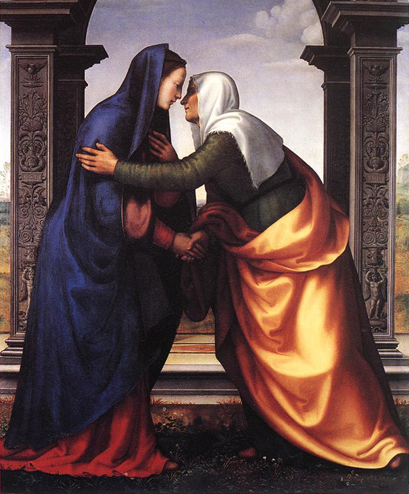
The feast of the Visitation, which we Catholics celebrate today, is a feast for expectant mothers, or at least it should be. What a joyful meeting that must have been between St Elizabeth and Our Blessed Mother, both pregnant by special Divine design! The one bearer of the forerunner of the Messiah, the other bearing the Messiah Himself. Both unexpected, yet joyfully accepted pregnancies.

While listening to our priest's homily this afternoon during Mass, a new thought struck me. Elizabeth and her husband, Zechariah, had waited years and years without the blessing of children. Otherwise successful, honoured, faithful Jews, this is their one black mark. Society would have viewed them as somehow having neglected their duty to God and incurred His disfavour. Then suddenly, in their old age, when they are far beyond dreaming of the possibility of children, God promises them a child.

Today, as a society, we have exactly the opposite problem from the one we see in the Gospel: we (thankfully) do not judge couples who are unable to conceive children as having brought down God's wrath, yet many times children are not viewed as a blessing to be desired, but rather an inconvenience (or a blessing under just the right circumstances). I was struck by the truth that many couples put off having children, not until their old age, but until a so-called opportune moment. Conversely, in this Gospel story Elizabeth and Zechariah would have dearly loved to have a child during their prime years.

Recently, I was reading a news article that cited how common it is for couples to put off having children into their mid-late thirties. Oftentimes, the author quoted a study, these same couples end up having to turn to extra-ordinary means to achieve pregnancy. The author pointed out that the success of these other un-natural means is highly overrated compared to actual rates. Another study recently pointed out that although many women believe that as more mature, settled women they will be better mothers, the reality is that younger women learn better the ropes of motherhood.

Seems we, again and again, rely on new science to rediscover what we should have known already from past cultural experience. Accept children as the blessings they are. Don't put off having children until some culturally perfect moment. Perhaps I'm preaching to the choir here, but we could all do with cultivating belief in the blessedness of children.